
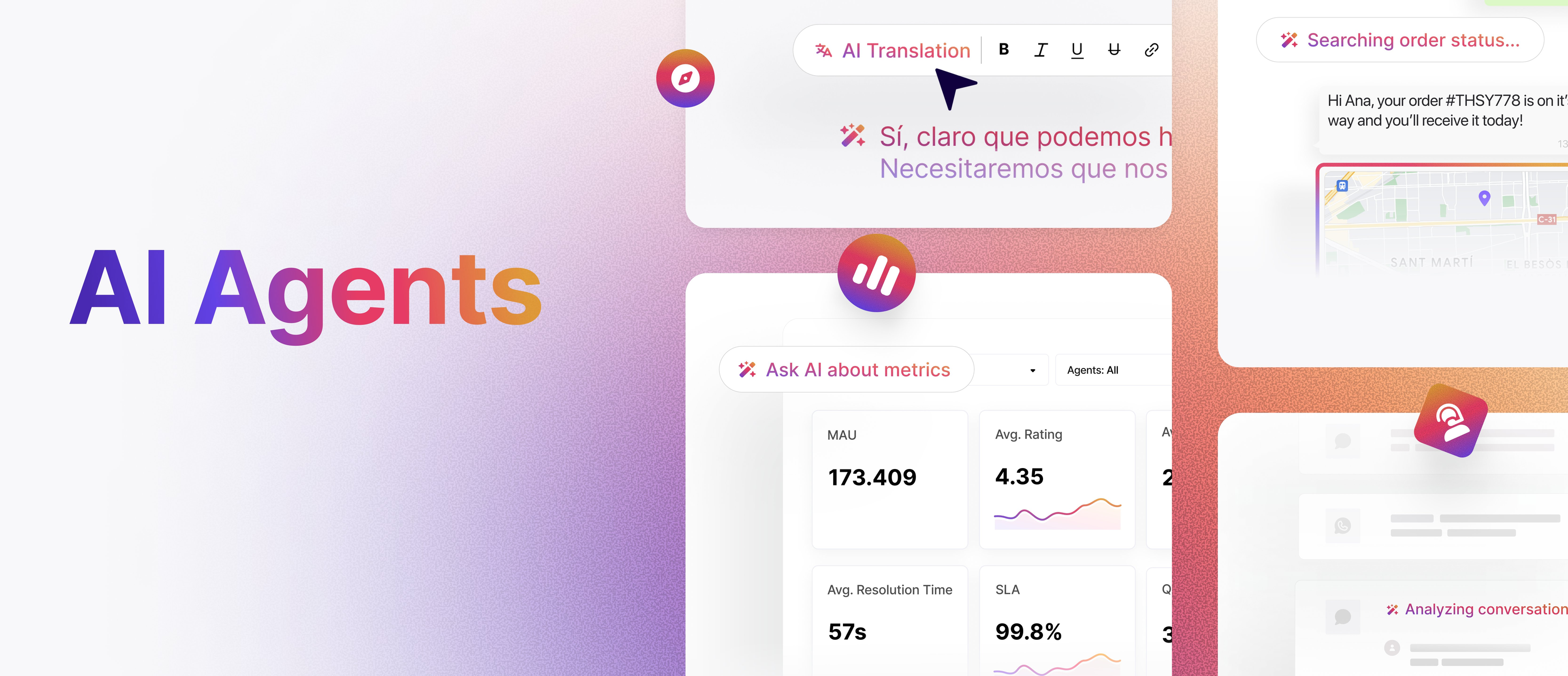

- Most chatbots respond — they don't act. Closing a sale, updating a CRM, or managing a return without human intervention requires a fundamentally different architecture.
- Hubtype's platform separates a central orchestrator from specialized agents: the orchestrator decides which agent acts, when, and with what information.
- Specialist agents reduce hallucination risk. A generalist model trying to solve everything is where most AI deployments break down.
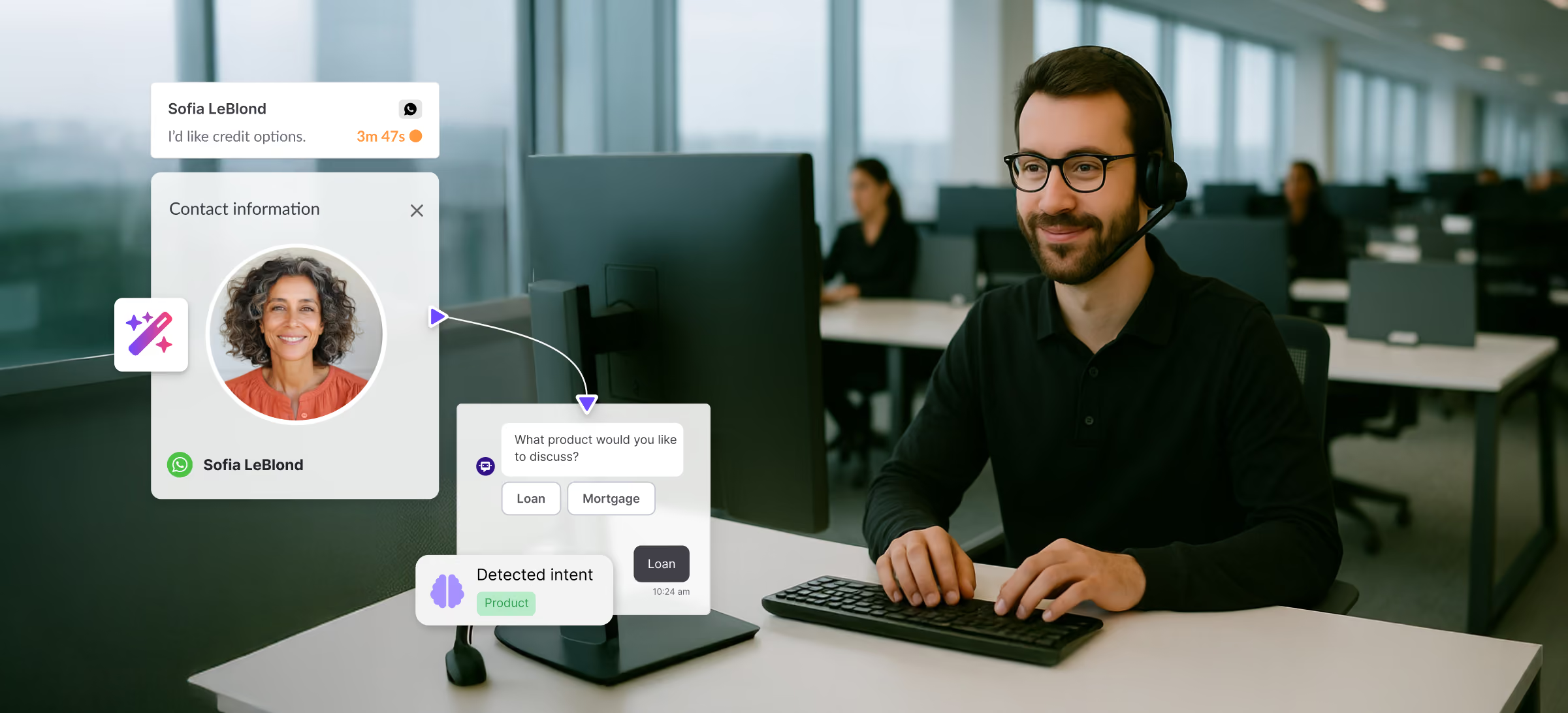
- When a case requires human empathy, the handoff includes full history, detected intent, and a structured summary. The customer never repeats themselves.
- Agents don't invent information. They access real data through tools connected directly to your systems.
- The platform covers the full business cycle from a single infrastructure: acquisition, sales, after-sales, support, QA, and analytics.
- Migrating from a traditional chatbot doesn't require rebuilding your stack. Agents layer on top of your existing CRM, APIs, and channels.
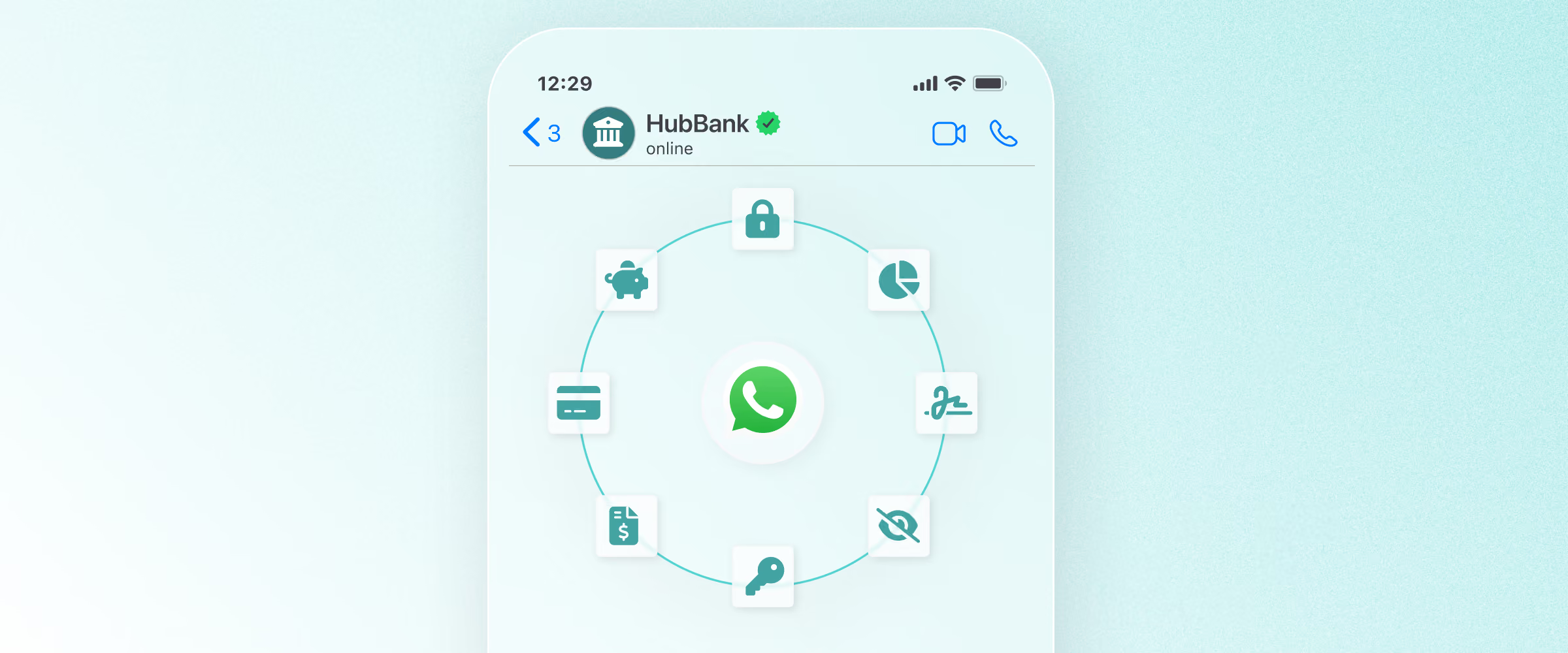
- All agents share the same security architecture: guardrails on every response, GDPR-compliant consent recording, private Azure OpenAI environments, and no use of your data to train external models.
Key points
Automating a conversation is the easy part. These days, any company can deploy a chatbot.
The challenge is for that chatbot to be able to close a sale, update a CRM, or manage a return without human intervention. It needs to complete the process, not just initiate it.
That’s where most solutions hit a wall, because a traditional chatbot responds, but it doesn't interact with your systems. It doesn't have access to your tools. It doesn't make decisions. It just follows a script.
Hubtype's AI Agents are designed to make autonomous execution a reality—controlled and measurable. Not just a roadmap promise.
The difference between responding and acting
The difference is technological and conceptual.
A rules-based chatbot is like an agent who can only read from a script, never truly grasping what the customer actually needs.In fact, if the client deviates from the intended flow, the system freezes or transfers to a human. Its entire logic depends on someone having anticipated and coded it beforehand.
An AI agent, on the other hand, acts like your best-trained employee who knows the company's code of conduct and has access to all the necessary tools to manage tasks independently. Of course, they reason about the context, make decisions, and complete processes from start to finish, such as closing a sale or updating a CRM, without needing constant supervision.
To ensure this level of autonomy is secure, our AI agents are specialists in various fields. They operate in conjunction with your tools and data, adhering to your company's policies to guarantee that every action is secure and aligned with your brand.
Discover how intelligent orchestration executes tasks and solves needs without human intervention → Getting to know AI agents
The platform: a central orchestrator and specialized agents
The core of our architecture is a multi-agent platform where the orchestrator decides which agent acts, when and with what information, without any element operating autonomously.
Instead of relying on a single AI model that attempts to solve everything, our infrastructure is based on the collaboration of two key pieces: a central orchestrator and an ecosystem of specialized agents.
The Central Orchestrator (The "Super Agent")
The orchestrator is positioned between the channel through which the user arrives, for example WhatsApp or Webchat, and the company's technology stack: APIs, CRMs, internal tools.
It acts as the brain of the operation, reviewing every input before any action is taken
And, as the true mastermind of the operation, the orchestrator works in the shadows making split-second decisions to assess user needs and assign the right specialist for the job.
In case the situation requires human empathy, it makes the transfer without friction, giving the human team all the previous context so that the client does not have to repeat their problem.
Multi-Agent Architecture
Under the control of the central orchestrator, we have multiple specialist agents with specific objectives and instructions.
By avoiding the concept of a "generalist bot", we reduce the risk of hallucinations or of the system becoming confused in complex situations.
These agents are divided into two categories:
Customer-facing agents
They are designed to cover the different phases of the user life cycle, interacting directly with the user in a natural way, but always under the rules of the business.
- AI Agent for Sales: Most business conversations are lost in the transfer from chat to web, from web to form, from form to sales team.
This agent stops those leads from slipping through the cracks. It qualifies the lead within the conversation, builds proposals based on the user's context, and handles objections in real time. The customer pays, books, or requests (and receives) a quote without leaving the chat.
- AI Agent for Customer Service: Nothing kills customer experience faster than having to repeat yourself. It's when it transfers the question to a human and the customer has to start from scratch.
This agent handles tasks autonomously: order status, modifications, and other related actions. When a case requires human intervention, the transfer includes the complete history, the detected intent, and a structured summary. The human agent then provides context so the customer doesn't have to repeat their case.
- AI Agent for Marketing: Mass messaging rarely works. This agent does the opposite: it identifies when there's a real need to contact someone, manages the frequency to avoid oversaturation, and tailors the content to the user's history, including their support tickets. The customer receives a message because it makes sense to them, not because it's scheduled on their calendar.
Internal use agents (for teams and operations)
The platform doesn't just interact with the end customer. It also deploys agents that operate in the background, integrating with your technology stack to boost employee productivity and structure your company's data.
- AI co-pilot for agents: A human agent stepping into a chat shouldn't have to spend minutes digging through history to understand the situation.
The AI Copilot reads the history, detects sentiment, and delivers a summary in under 5 seconds. It translates in real time and suggests responses using the user's data already entered. This allows the human agent to jump right in and resolve issues, instead of catching up.
- AI Agent for Data Capture: Every conversation generates data. The problem is that most of it ends up buried in the chat text, unstructured, unsynchronized, and useless to the team.
This agent extracts key entities in natural language—order IDs, dates, emails—and automatically syncs them with the correct field in your CRM. It does this without interrupting the conversation and without relying on a human agent to do it manually.
- AI Agent for QA: Manual QA covers a tiny fraction of actual conversations. The rest is never reviewed: there's no auditing, no alerts, no way to know what's going wrong.
This system continuously audits all interactions and generates real-time alerts when a metric drops. But most importantly for operations, it allows you to simulate conversations to detect errors before they reach the end user.
- AI Agent for Analytics:How many sales actually came from WhatsApp this month? Why did the average resolution time increase last week?
Questions that currently require requesting data from the BI team or waiting for manual analysis are answered by this agent in seconds, in natural language, without SQL. It correlates metrics to explain the exact origin of an anomaly and generates visualizations on the fly, for any manager, without relying on technical support.
Security, control and compliance
All these agents share the same security architecture. Each response passes through control layers (guardrails) that define what the agent can and cannot do, and how it should communicate, acting as a filter before any message reaches the user.
Furthermore, to eliminate the risk of hallucinations, the agents don't work with assumptions: they access real data through tools directly connected to your systems. If the information doesn't exist in your stack, the agent doesn't invent it.
At the infrastructure level, the entire operation runs on Azure OpenAI, in private environments that meet the most demanding corporate standards. Before processing any personal data, the agent requests and records the user's explicit consent in accordance with GDPR, leaving complete legal documentation on your system. And under no circumstances is your data used to train external models.
The next step for your stack
The transition from a traditional chatbot to AI agents does not require throwing away what you already have or starting from scratch.
Hubtype AI agents integrate on top of your existing stack, your CRM, your APIs, your channels, and gradually take over processes.
They act as a comprehensive orchestration platform: each piece shares context and operates on your existing systems to cover the entire business cycle: acquisition, sales, after-sales, support, quality, and analytics.
It's not about adding a layer of AI on top of what you already have. It's about making what you already have work from start to finish without human intervention at every step.
It’s not just a new tool—it’s the next logical step for your operations.





.avif)