- Companies that open WhatsApp get more out of it when they roll it out in phases.
- The automation rate should go hand in hand with a quality measure, because a conversation with no human agent involved can hide a customer who gave up without an answer.
- An AI agent connected to the CRM recognizes customers by their phone number, asks only for the details it's missing, and can qualify a lead and book the sales meeting.
- A virtual personal shopper connected to the catalog and stock puts the personalized recommendations that used to go only to VIP customers in front of many more of them.
- A channel that resolves combines button-based flows, in-chat forms, AI agents and connections to company systems, and hands off to a person along with the customer's context.
Key points
Plenty of companies open a WhatsApp channel to take pressure off the phone lines and start selling in the chat. A few months later, customers are still repeating details they've already given, waiting on replies that never come, or getting recommendations that have nothing to do with them.
There are usually three problems behind it: the channel launched without clear priorities or a way to measure quality, it isn't connected to the company's systems, or it treats every customer the same.
In the webinar "You Opened WhatsApp, but It's Not Working: How to Get the Most Out of It", hosted by Hubtype and AEERC, Juan Ollero, Head of Product and Applied AI, and Marta Marrón, Customer Experience lead, walk through how to spot each of these problems and where to start fixing them.
1. The channel isn't saving work or generating revenue
When the channel isn't saving work or bringing in revenue, the fix has two parts: move in phases and measure the quality of what you automate.
Move in phases
Juan Ollero suggests going back to the starting question: what did you want to improve when you opened WhatsApp, and what's changed since then? He explains it with the example of an airline and its three levels of requests:
- Starting point: passengers get an answer to a common question or check their ticket without waiting. It's the easiest level to launch.
- Transactional: passengers add a bag or pick a seat without leaving the chat. This is where the airline starts earning revenue through the channel.
- Maximum impact: passengers search for a flight, book it and pay for it in WhatsApp. It brings in the most revenue and takes the most technical work.
"Nobody starts out selling tickets on WhatsApp. It's something you work your way up to."
A project that tries to automate everything from day one is more likely to never reach production, and in the meantime the company goes without feedback from its customers. That's why Juan recommends starting where the weight is: the request with the most volume, the workload peak, or the reason customers keep calling. If the project is well scoped, simple use cases can be live in one or two weeks.
Marta shares the case of a low-cost airline her team has worked with for two years. Before opening WhatsApp, it handled customers by phone and email, two expensive channels with no automation.
In under six weeks, it launched WhatsApp with answers to frequently asked questions. Next, it integrated the agent with its systems so every passenger could check their booking. Today it automates more than 85% of conversations.
The next step was selling ancillaries and, more recently, the full ticket purchase, payment included. According to Marta, the revenue the agent brings in already covers the cost of the service.
Measure quality
To know when to move from one phase to the next, Marta suggests measuring how much gets automated and how well. She warns that the automation rate, which her team tracks in real time, isn't enough on its own:
"You have to be very careful with this metric. There can be a lot of conversations with no human agent involved where the virtual agent isn't giving a good answer."
Her team pairs that metric with a quality score from an AI agent they call the judge agent. It reviews conversations against defined criteria and scores each one. That's how they catch cases where a high automation rate hides a customer who got fed up and left, or who asked to talk to a person and never got the option.
Marta adds cost as an indicator: what the channel costs, what it saves, and how it compares with the others.
In airlines, for example, it's common to offer customers a switch to WhatsApp when the phone lines are overloaded. Because the channel is asynchronous, an agent can reply within minutes, or within an hour at peak times, and it's still cheaper than voice. On webchat, by contrast, if a human agent doesn't reply, the customer closes the window after three minutes and you lose them.
Marta sums up where these projects are heading: customer service is moving from a cost center to a revenue center, with cross-selling opportunities.
2. The channel isn't connected to your systems
When WhatsApp isn't connected to the CRM or the rest of the company's systems, the AI agent handling the channel doesn't know who it's talking to. The fix is to give it access to that data, first so it can recognize the customer and then so it can act on that data.
Juan points out that the company already knows this customer, but on WhatsApp it treats them like a stranger. The customer has to explain all over again who they are, what the problem is and where they're coming from, and satisfaction drops.
Marta estimates that around 90% of her team's projects use AI agents with access to tools, because the information the customer needs lives in the transactional system or the CRM. In ecommerce, for example, the agent checks the system and tells the customer whether the order is out for delivery or already delivered.
An agent that qualifies leads and books meetings
With that same access, the agent can do more than look things up. It can save data to the CRM, apply criteria and book an appointment.
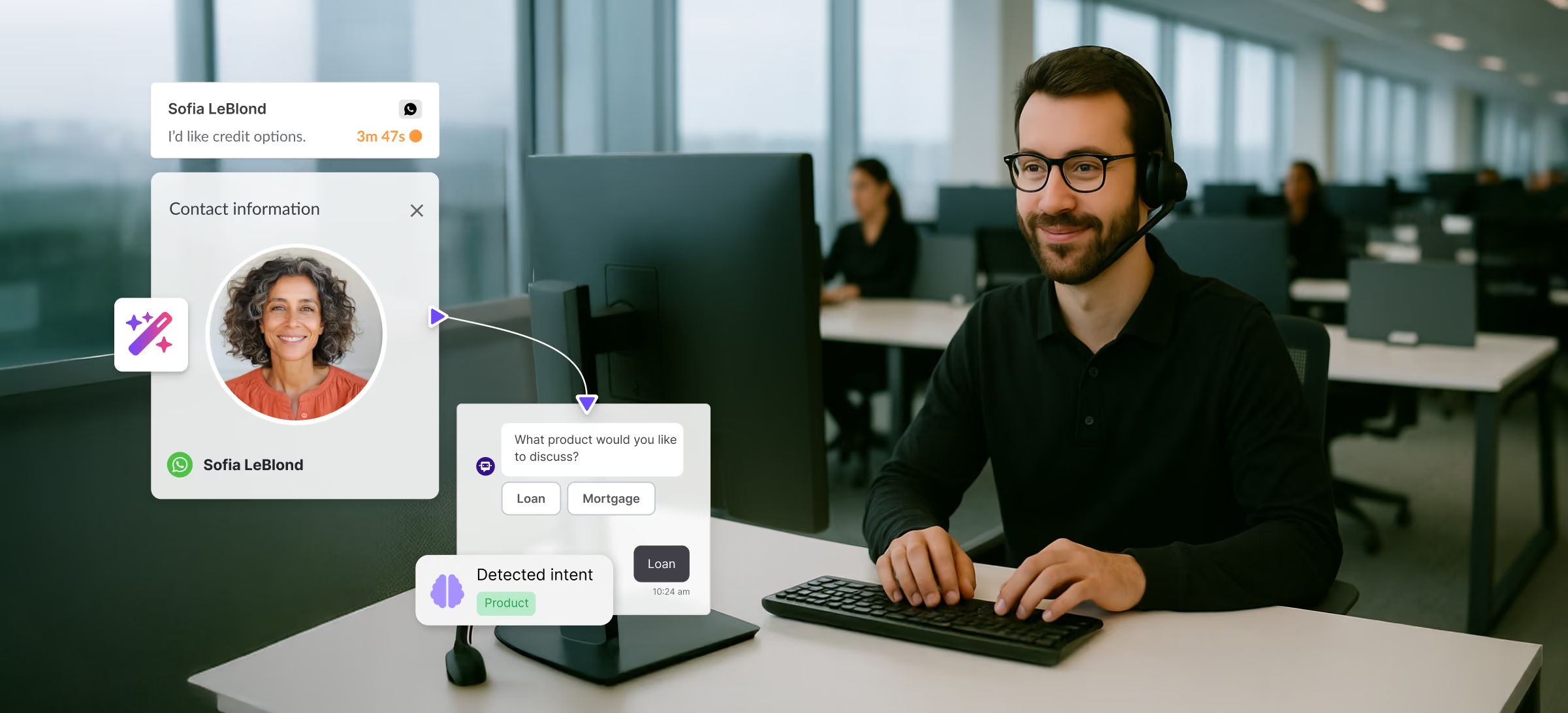
Marta walks through the case of a financial institution that needed to qualify people interested in a loan. Its sales reps didn't have the capacity to call everyone and collect their details. The WhatsApp agent follows this path:
- Recognize: it identifies the phone number and checks the CRM, HubSpot for example. If the person has shared information before, it greets them by name.
- Ask: it requests only the missing details, such as savings, salary, age or place of residence, and sends them to the CRM.
- Decide: it checks the person against the defined criteria and, if they don't qualify, explains why.
- Book: if they qualify, it checks the sales reps' calendars and locks in a day and time for a meeting.
The result, Marta says, is thousands of meetings booked every month. The sales team stops spending time on screening and only talks to people who meet the criteria.
Integrate without waiting to have everything in place
A case like the financial institution's depends on several integrations. Even so, Juan stresses that you don't need them to get started: the channel can launch with simple automation. He adds that many companies think they have no systems available, and then internal tools or an API turn up that can be reused as a first step.
What you do have to plan for is maintenance. Both speakers warn about the complexity hidden behind plug-and-play solutions, and Juan gives an example: when a new model comes out, the agent may stop behaving as expected. The prompt needs rewriting, tools stop responding, or an integration breaks.
3. The channel treats every customer the same
The third problem shows up when the channel never gets past FAQs and treats every customer the same way. The fix is to connect the AI agent to the catalog and ask each customer what they need, so it can recommend accordingly.
Marta explains it with the example of an international fashion brand. The brand had a team dedicated to clienteling: it reached out to VIP customers whenever a new collection or sale launched and recommended pieces based on their preferences and size. It was profitable, but it only reached the customers that team could handle.
To scale it, the brand launched a virtual personal shopper: an AI agent connected in real time to the catalog, with descriptions, images, prices and stock. The agent asks the questions it needs to understand what the customer likes and what they need right now, and recommends pieces.
Marta insists that every AI agent needs a defined goal. In this case, the goal was conversion: recommending pieces that match the customer's taste so they click and buy. That's why the agent doesn't just answer catalog questions. It asks what it needs to narrow down what the customer is after, and every recommendation points to an item they can buy right then.
Juan adds that the brand also uses the channel for outbound, with campaigns that suggest products or new arrivals to each customer. WhatsApp serves customers when they reach out, and it also lets the brand reach out to them.
From a channel that answers to one that resolves
The fixes for all three problems come together in a single journey.
For Juan, a channel that resolves completes the request in a personalized way inside the conversation and only hands off to a person at specific moments. Getting there means designing the user experience end to end, deciding which technology comes in at each step, and reviewing the project critically to see what's missing.
Which technology comes in at each step
On design, Juan explains that not everything has to be generative AI. He separates three pieces, each covering a different part of the conversation:
- Deterministic flows, with buttons, fit where each option has to return a specific message.
- Webviews, visual interfaces that open inside WhatsApp, are for collecting data with real-time validation.
- AI agents come in when you need to understand, qualify or convert, and with custom tools they can take action in the company's systems.
Handoff to a human agent completes the design. Marta explains that some use cases need a person, for example when the AI agent doesn't have access to the transaction the customer is asking for. She adds that the law requires companies to tell customers they're talking to an AI agent and to transfer them to a person if they ask.
Juan spells out what the person taking over needs to know: why the customer got in touch, who they are, what the problem is, what mood they're in, and what conversations they've had before.
Three questions to review a WhatsApp channel
Designing the channel with these pieces works for a project that's just starting. For a channel that's already live and not delivering results, the first step is figuring out what's missing. For that, Marta poses three questions that pick up on what came up throughout the webinar: what to automate, with what data, and how to check it's working.
- Use cases: which of the company's requests can be handled through WhatsApp, and which are worth automating to free up resources?
- Integration: what data do those use cases need that isn't in the channel, and how will the AI agent get to it?
- Quality: how will you check that what you've built answers what the customer is actually asking?
What the three fixes have in common
A company that opens WhatsApp and sees no change in its operations usually has customers repeating details they've already given, waiting on replies that never come, or getting recommendations that have nothing to do with them.
Juan and Marta's fixes point in the same direction: start with the request that carries the most weight and measure its quality, connect the AI agent to the systems where the answer lives, and use that data to serve each customer based on what they need. That's when the channel starts closing out requests and, in cases like the airline's, sales too.