
Agents
Key Concepts
Agents tab is split into two different dashboards, one regarding the performance and the other one regarding the availability. Metrics for each one are the following:
Agent performance
Agent name: Self explanatory.
Assigned cases: Number of unique cases assigned to this agent (cases where the agent was responsible for handling at any point).
Attended cases: Number of unique cases where this agent sent at least one message to the enduser
Resolved cases: Number of unique cases where this agent achieved a successful resolution (resolution_status = 'result_ok'). Credit goes to whichever agent has the case at the time of resolution. Cases with resolution_status = 'result_not_solved' or null are excluded. If Agent A starts a case but Agent B resolves it, only Agent B gets resolution credit. Cases marked as discarded (typification = 'discarded') may still be counted as resolved if resolution_status = 'result_ok'. If a case is resolved multiple times by different agents, each agent will get credit.
Discarded cases: Number of unique cases where this agent marked the case as discarded (typification = 'discarded'). Credit goes to the agent who applied the discard typification. A case can theoretically be both discarded and afterwards resolved.
Multiple times a case is discarded will count to all the agents who discarded it.
AAT: Average time cases spend in 'attending' status when assigned to this agent. Includes every attending period across all cases (if a case returns to attending status multiple times with this agent, all periods are included). Start time: when case enters attending status with this agent. End time: when case exits attending status. Weighted (duration_case_state_secs / duration_case_attending_secs) by proportion of total attending time per case. Includes all elapsed time including queue closed periods. If Case A spent 100 minutes in attending status total, and Agent 1 handled it for 60 minutes, Agent 1's weight is 0.6. Only case_status = 'status_attending' periods
ART: Average time from when case goes to 'attending status' with this agent until they send their first message in that attending period. Includes every separate attending period across all cases (multiple measurements per case if agent handles same case in different attending periods). Start time: when case enters attending status with this agent. End time: when agent sends first message in that attending period. Includes all elapsed time including queue closed periods. If Agent A handles the same case in attending status twice (due to transfers), both periods generate separate ART measurements. Case goes Agent A → waiting → Agent A again = 2 ART measurements for Agent A. If case enters attending status at 5 PM but queue closes at 6 PM, and agent responds at 9 AM next day, full overnight duration is counted.
AFRT: Average First Response Time is the average time since the case goes to 'attending status' until the agent answers, whenever they are the first agent responding. Only measures cases where this agent was the chronologically first agent to handle the case in attending status. Start time: when case first enters attending status with this agent. End time: agent's very first message in the case. Maximum one measurement per case, but can be null if agent was never first responder. Includes all elapsed time including queue closed periods. AFRT vs ART: AFRT measures initial customer service speed, ART measures individual agent responsiveness
Avg rating: Average customer satisfaction rating weighted by time spent in attending status. When multiple agents handle the same case, they all receive the same rating value but weighted by their proportion of total attending time in that case. Agent who spent more attending time gets higher weight for that rating. Only includes cases where agent sent messages during attending periods. Case rated 4/5, Agent A handled 30 minutes, Agent B handled 70 minutes. Agent A gets rating of 4 with weight 0.3, Agent B gets rating of 4 with weight 0.7. Agent B's average is more influenced by this case
Ratings: Self explanatory.
Agent time spent in status
Agent name: Self explanatory.
Time available: Total time agent was logged in and available to receive new cases. Start time: when agent changes to 'available' status. End time: when agent changes away from 'available' status. Measures productive time when agent can accept new work, in seconds.
Time busy: Total time agent was logged in and actively handling cases. Start time: when agent changes to 'busy' status. End time: when agent changes away from 'busy' status. Measures active work time handling customer cases, in seconds.
Time away: Total time agent was logged in but marked as away/unavailable. Start time: when agent changes to 'away' status. End time: when agent changes away from 'away' status. Includes break time, in seconds.
% Time available: Percentage of total online time spent available for new cases. Calculated as (available_secs ÷ total_online_secs) × 100. Shows agent's readiness/availability rate while logged in.
% Time busy: Percentage of total online time spent actively handling cases. Calculated as (busy_secs ÷ total_online_secs) × 100. Shows active work utilization rate while logged in.
% Time away: Percentage of total online time spent in away status. Calculated as (away_secs ÷ total_online_secs) × 100. Shows break/unavailable time rate while logged in.
How to use it?
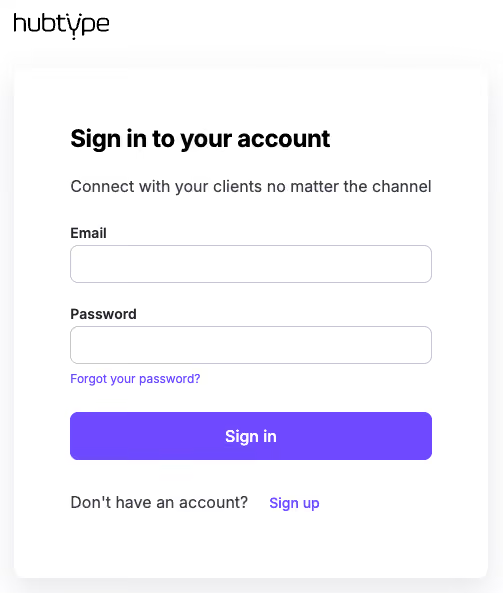
To use it, first log into your account:
Navigate into the left-side bar and click the Agents section.

Take the most of your data! Filters are also available.
Examples or Use Cases
Sarah, a Team Lead at an international e-commerce company, starts each morning by opening the ‘Agents’ tab to review her team's performance from the previous day. Her team handles customer inquiries across English, French, and German channels through WhatsApp.
She filters the data to show yesterday's metrics and immediately notices that Agent Maria has an Avg. Rating of 4, significantly higher than her average of 3.5. Investigating deeply, she found out that, while the Average Attending Time and the Average Resolution Time didn’t improve, her Average First Response Time was faster than ever! Good job Maria, keep it up!
Best Practices
Filters available to subset the whole data.